1: Activation of a Carbonyl Compound by Halogen Bonding; Chem. Commun., 2014, 50, 6281-6284
S. H. Jungbauer, S.M. Walter, S. Schinder, L. Rout, F. Kniep and S. M. Huber
https://doi.org/10.1039/C4CC03124E
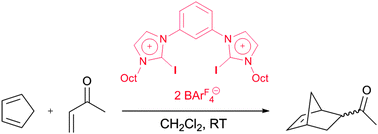
Halogen bond Catalysis: Using a prototypical Diels–Alder reaction as benchmark, we show that dicationic halogen-bond donors are capable of activating a neutral organic substrate. By variouscomparison experiments, the action of traces of acid or of other structural features of the halogen-bond donor not related to halogen bonding are excluded with high certainty.
S. H. Jungbauer, F. Kniep, S.M. Walter, S. Schinder, L. Rout, and S. M. Huber https://doi.org//10.1055/s-0033-1338981
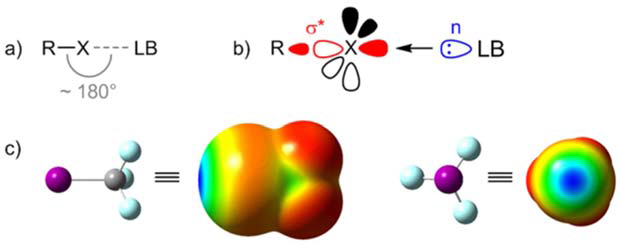
What is Halogen Bond, A Review: Although halogen bonds share many similarities with hydrogen bonds, they have so far found virtually no application in organic synthesis. This account summarizes our efforts to use multidentate halogen-bond donors (halogen-based Lewis acids) in formal halide abstraction reactions. Following a first proof-of-principle study, we recently reported the first halogen-bond-based organocatalytic carbon–carbon bond-forming reaction.
3: 5-Iodo-1,2,3-triazolium-based multidentate halogen-bond donors as activating reagents, Chem. Comm,2012, 48, 9299.
F. Kniep, L. Rout, S.M. Walter, H. K. V. Bensch, S. H. Jungbauer, E. Herdtweck and S. M. Huber.
https://doi.org/10.1039/C2CC34392D
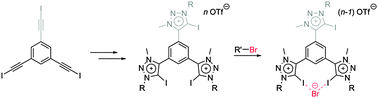
Abstract: Bi- and tridentate polycationic halogen bond donors based on 5-iodo-1,2,3-triazolium groups have been synthesized by 1,3-dipolar cycloaddition reactions. These halogen-based Lewis acids have been evaluated as activators in a halide-abstraction benchmark reaction.
4: Isothermal Calorimetric Titrations on Charge-Assisted Halogen Bonds: Role of Entropy, Counterions, Solvent, and Temperature J. Am. Chem. Soc. 2012, 134, 8507-8512.
Sebastian M. Walter, Florian Kniep, Laxmidhar Rout, Franz P. Schmidtchen, Eberhardt Herdtweck, Stefan M. Huber.
https://doi.org/10.1021/ja2119207
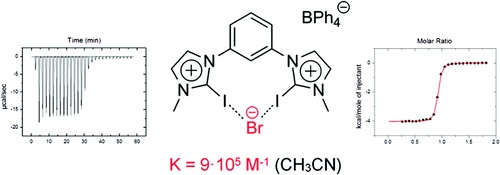
Abstrcat: We have conducted isothermal calorimetric titrations to investigate the halogen-bond strength of cationic bidentate halogen-bond donors toward halides, using bis(iodoimidazolium) compounds as probes. These data are intended to aid the rational design of halogen-bond donors as well as the development of halogen-bond-based applications in solution. In all cases examined, the entropic contribution to the overall free energy of binding was found to be very important. The binding affinities showed little dependency on the weakly coordinating counteranions of the halogen-bond donors but became slightly stronger with higher temperatures. We also found a marked influence of different solvents on the interaction strength. The highest binding constant detected in this study was 3.3 × 10⁶ M–1.